
Soundeffect.

Words and audio

What are sound effects called in writing, and which term fits?

The short answer to what are sound effects called in writing is usually onomatopoeia when a word imitates a noise. Descriptive prose, comics, and scripts use other terms too; the right name depends on what the words do.

Soundeffect audio-themed hero artwork

3 misconceptions about written sounds

A written sound effect is not always an imitation, and a word on the page is not itself a playable recording.

Fiction writers

Mistake every mention of noise for onomatopoeia. “The door slammed” describes an event; “bang” imitates its sound.

Choose imitation only when the sound itself deserves attention. For a different medium, see what is sound effect in music.
what is sound effect in music

Comic creators

Assume a printed “crash” is an audio file. It is visual text that invites the reader to imagine a noise.

Treat lettering, scale, and placement as storytelling choices. For concrete categories, see sound effects examples.

sound effects examples

Screenwriters

Put every noise in dialogue. A cue such as “A GLASS SHATTERS” usually belongs in action, not a character’s speech.

Give production readers a clear event to interpret. For moving-image context, see sound effect for youtube.

sound effect for youtube

Video editors

Expect the written cue to supply the finished sound. A script describes an audible event; an edit needs an audio asset.

Separate the direction on the page from the recording on the timeline. For that distinction, see sound effect vs audio.

sound effect vs audio

What it actually is

Onomatopoeia names words that echo sounds. It does not name every technique for representing sound in writing.

  1. 1

    Identify the medium

    In prose, a writer can describe a sound or imitate it. In comics, a lettered “whoosh” may also function as a visual design element. In scripts, a sound cue tells readers what should be heard in the scene.

  2. 2

    Identify the wording

    “Buzz,” “hiss,” and “thud” can be onomatopoeic words because their forms suggest noises. “The engine grew louder” is sound imagery or description: it conveys hearing without spelling out the noise.

  3. 3

    Identify the job

    A written sound effect might establish location, mark an impact, interrupt dialogue, or set a rhythm. Pick a term for the technique you used, then decide whether readers need the exact noise or merely its consequence.

When NOT to use it

Calling everything on the page onomatopoeia can obscure what a passage or production cue actually needs.

1

Do not label plain description as imitation

“Rain tapped against the window” conveys a sound, but the sentence does not have to be classified as an onomatopoeic sound effect.

What to do instead

Call it auditory imagery or sound description when the words evoke hearing without imitating the noise.

2

Do not let lettering replace clarity

A string of “boom” and “crash” cues can leave readers unsure what happened, where it happened, or why a character reacts.

What to do instead

Name the source or consequence when it matters: “A metal tray falls. Clang.”

3

Do not treat a cue as a recording

A stage direction specifies an event, not a finished waveform. It cannot establish a recording’s quality, suitability, or usage rights.

What to do instead

Choose and assess the actual audio separately when the work moves into production.

From description to sound

Illustration for the concept of sound effects in writing
Written concept
Illustrative sound-design artwork
Audio context

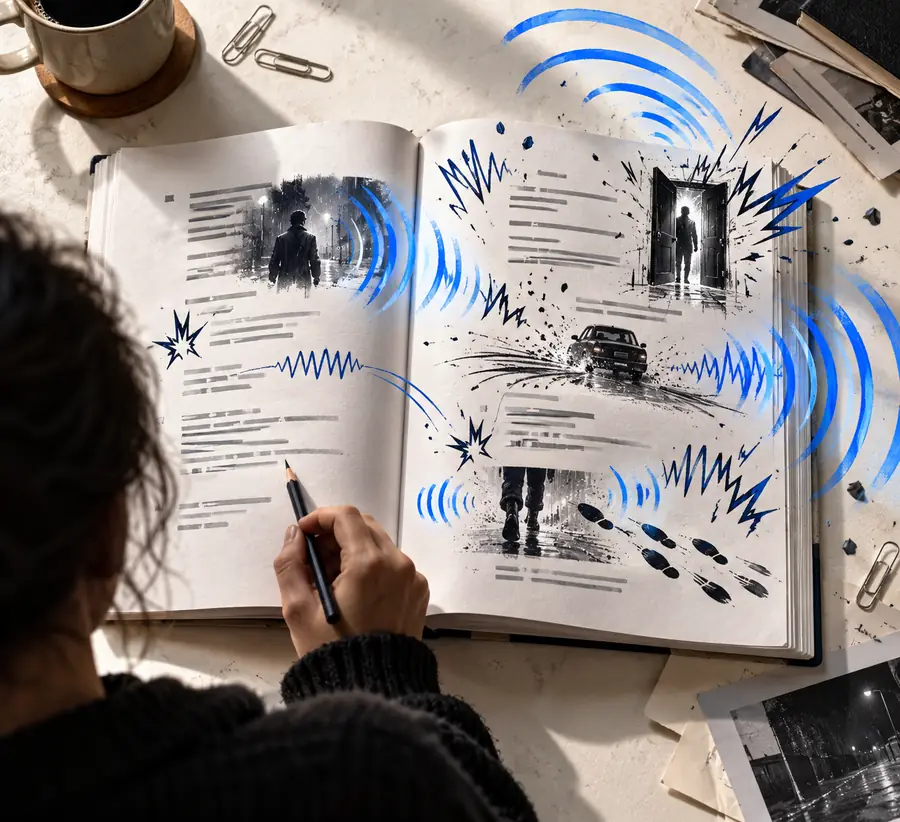
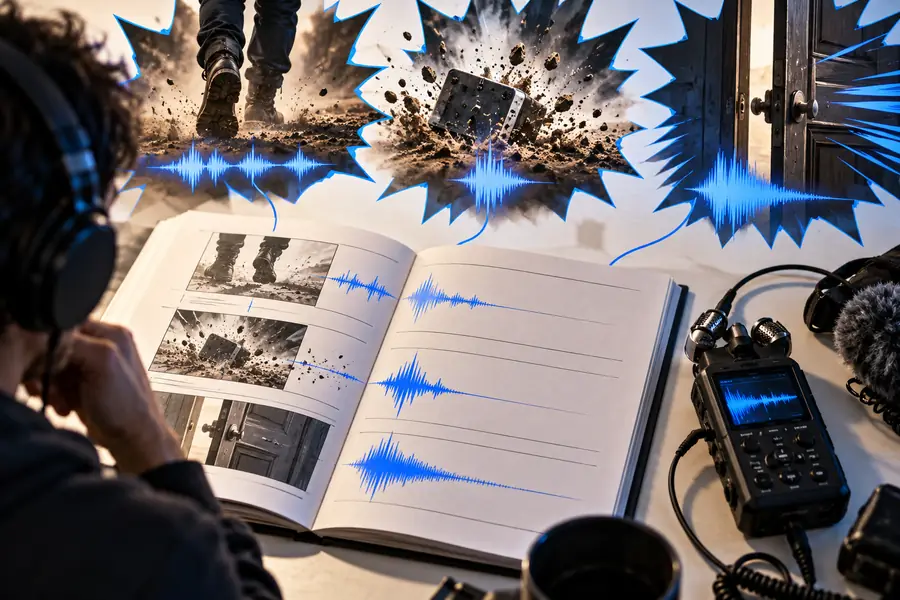
These images illustrate a change of medium, not a literal before-and-after conversion. A phrase such as “footsteps on gravel” gives direction; a recorded sound requires separate creation or selection.

Written conceptAudio context

Written sound terms at a glance

These are categories, not interchangeable names for the same thing. The examples show how a sound effect on the page differs from a broader description.

Onomatopoeia Other written sound cues
Core idea A word imitates or suggests a noise. Words describe, instruct, or evoke something heard.
Prose example “The latch clicked.” “The latch gave way behind her.”
Comic example A lettered “KRAK” marks an impact. A caption describes the building settling.
Script example “BANG” conveys the character of a noise. “A door slams offscreen” specifies an event.
What readers receive A suggested noise in the form of a word. Context about the source, setting, or effect of a noise.
What neither supplies A playable recording. A playable recording.

Keep the distinction clear

Once your scene calls for a sound effect a listener will actually hear, the words become a brief rather than the finished result. Soundeffect can point you toward an audio-focused workflow; assess any resulting audio for your project and its intended use.

Take a written cue into an audio workflow

  • Describe the source and action
  • Specify the setting and intended mood
  • Review the actual audio separately
Explore audio tools

FAQ

The term is onomatopoeia. Words such as “buzz” and “clang” suggest the noises they name, though people may interpret those imitations differently.

No. A writer can evoke hearing through auditory imagery, describe a noisy event in ordinary prose, or give a sound cue in a script. Onomatopoeia applies when the wording itself imitates or suggests a noise.

Comic sound words are often called sound effects or onomatopoeia. Their lettering and placement can help show timing and impact, but the printed words are still not recorded audio.

Write a clear cue that identifies the audible event and where it matters to the scene. A concise direction such as “A GLASS SHATTERS offscreen” tells readers more than an unexplained noise word alone.

Create a sound
Create a sound